.svg)
Here are 10 builder-led factors that help homeowners make clear, confident decisions.
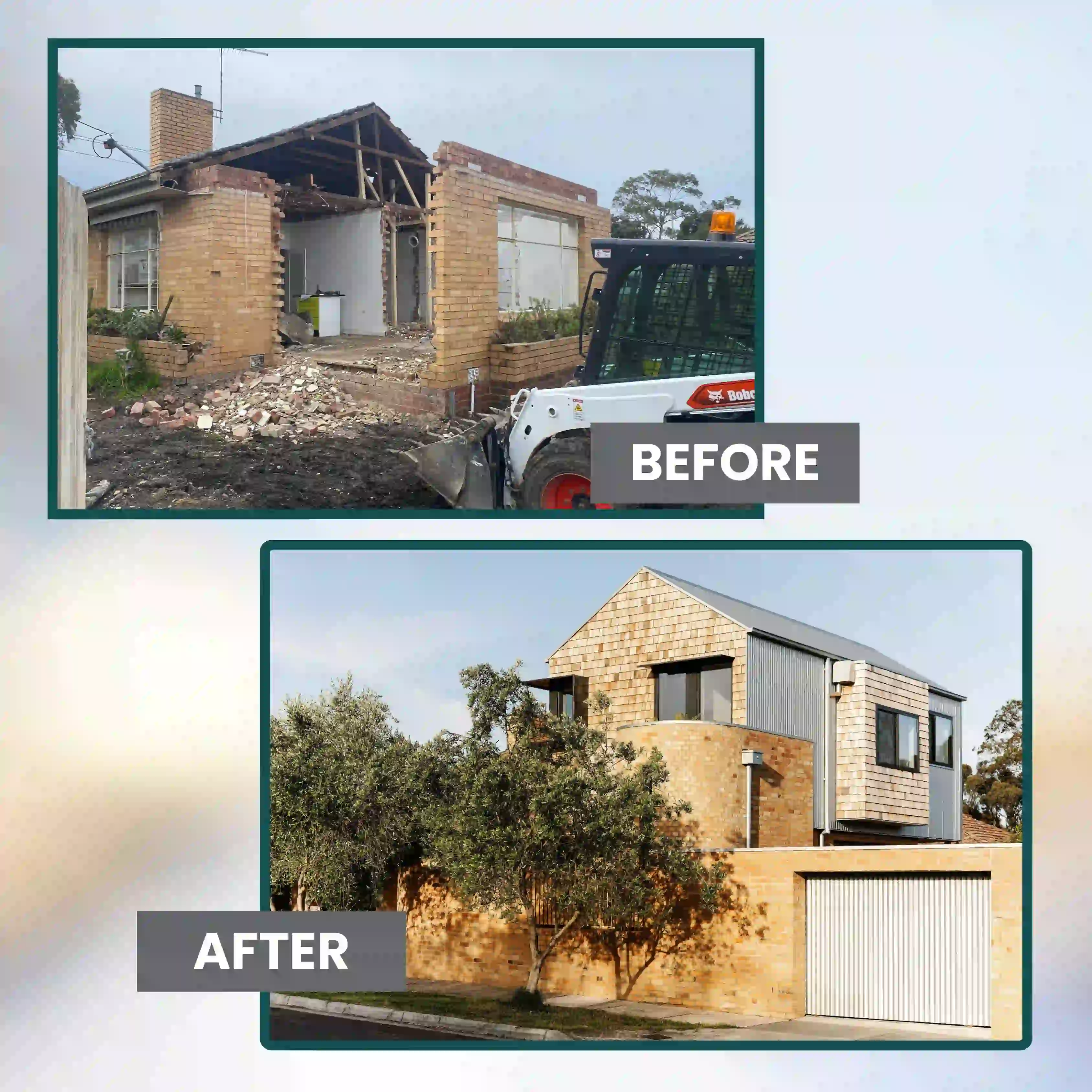
Most homeowners reach a point where their home stops working. The layout feels tight. The light feels limited. Comfort feels inconsistent. Or the building simply feels tired.
That’s when the big question appears:
Do we renovate, or do we knock down and rebuild?
We hear this constantly, especially from inner-city homeowners. This decision shapes your budget, timeline, and long-term satisfaction.
We recommend answering it logically, not emotionally.
This decision becomes much easier when you separate the two things.
First, what you want emotionally. That might include keeping character, preserving memories, or holding onto parts of the home you love.
Second, what the site and structure will allow logically. That includes drainage, movement, planning, and budget predictability.
We can often achieve the emotional goal in more than one way. Sometimes that means renovating. Sometimes that means rebuilding but retaining elements of your home that matter. The key is choosing a pathway that doesn’t punish you later with construction cost blowouts or compromises you didn’t expect.
Here are the 10 factors we use to guide this decision.
Planning rules can make the decision for you.
Heritage overlays, neighbourhood character controls, and local policies can limit demolition or force partial retention.
We never recommend designing first and checking planning later. Planning shapes what’s possible.
Even without strict heritage, councils often protect streetscape rhythm.
If your home contributes strongly to the street, a renovation may create a smoother pathway.
If the existing façade has limited value, a rebuild can offer more freedom.
Renovation becomes difficult when the structure has significant movement.
Floors slope. Walls crack. Openings twist.
Some movement is normal, but major movement incurs high costs and risks before lifestyle improvements even begin.
Movement doesn’t only affect cracks. It affects the entire home experience. Floors can feel uneven underfoot. Cabinets can go out of square. Windows can stop operating smoothly. Waterproofing can fail faster when the structure shifts.
When we see a major movement, we also consider what caused it. Soil conditions, drainage issues, and past structural changes can all play a role. If the cause remains active, a renovation can become an ongoing repair cycle. A rebuild may allow you to properly address the root cause through engineering and site corrections.
Older homes often sit low relative to the external ground.
If internal floor levels sit too close to external ground, moisture and drainage issues can become constant.
A rebuild can properly reset floor levels. A renovation can work, but it must respect water management.
Floor height is also a planning and design issue, not just a drainage issue. When the floor sits too low, homeowners often try to fix it with small surface solutions like extra drains or regrading outside. Those fixes rarely solve the long-term problem, and often appropriate civil drainage designs are required.
A rebuild gives you the chance to reset levels from the beginning. That can protect the structure and improve comfort. It also helps with internal layout because you can design transitions, steps, and outdoor connections properly instead of forcing them to work around an old level that no longer makes sense.
Inner-city sites often restrict access.
Renovations can increase labour costs because trades must protect the existing structure while working through tight boundaries.
A rebuild can simplify sequencing by removing unknown conditions.
Some homes force compromise through poor layouts, narrow corridors, and poor outdoor connections.
Renovations can improve layouts, but not always efficiently.
If the existing plan fights every improvement, a rebuild may deliver a cleaner outcome.
Older homes often struggle with insulation, glazing, and airtightness.
A renovation can lift performance, but it requires careful detailing.
A rebuild offers full control over orientation, envelope, and thermal performance from the start.
Renovations can cost less, but they bring unknowns.
Hidden structural decay, asbestos, outdated systems, and water damage can quickly change the budget.
A rebuild usually offers much more cost predictability.
We also encourage homeowners to think about cost predictability, not just cost. A renovation may look cheaper on paper, but it can carry a much wider range of outcomes. One hidden issue can shift the entire budget.
A rebuild often has a clearer baseline. You can still face variations, but you don’t carry the same unknowns behind walls and under floors. This is why many homeowners feel more relaxed after choosing a rebuild. They know what they’re paying for and why.
Renovations can take longer due to constant micro-decisions and custom junctions.
A rebuild often follows a clearer sequence and reduces decision fatigue.
Time is a cost, too.
Renovations can reduce demolition waste and preserve embodied carbon.
A rebuild can still support sustainability through salvage, reuse, and long-term performance.
We encourage homeowners to consider sustainability across the full life of the home.
If you feel stuck between the two options, we recommend doing one thing early. Get clear advice before you lock in design decisions.
That may include reviewing planning controls, checking levels, assessing structure, and understanding site access. Once you have that information, the decision stops feeling like a guess.
A good outcome comes from clarity, not optimism.
A renovation works best when:
A rebuild works best when:
Either way, the goal stays the same.
We want a home that feels good to live in, performs well, and reduces compromise.


